How to Read a Payslip in Spain: Complete Guide 2026
Learn to read your payslip: earnings, deductions, income tax, contribution bases and how to detect errors. Step-by-step 2026 guide with MEI 0.15%. Check yours now!
💡 Want to know if your payslip is correct? Calculate your expected net salary
👉 Net salary calculator
What is a payslip?
The payslip or salary receipt is the document that reflects the remuneration you receive for your work. It's a mandatory legal document that your company must provide you every month.
Knowing how to read a payslip allows you to:
- ✅ Verify that you're being paid correctly
- ✅ Understand your deductions (Income Tax, Social Security)
- ✅ Detect errors or discrepancies
- ✅ Know your contribution bases (affect your retirement)
- ✅ Plan your personal finances
Structure of a Spanish payslip
A payslip is divided into 4 main sections:
- Company and worker data
- Earnings (what you earn)
- Deductions (what is deducted)
- Net pay (what you receive)
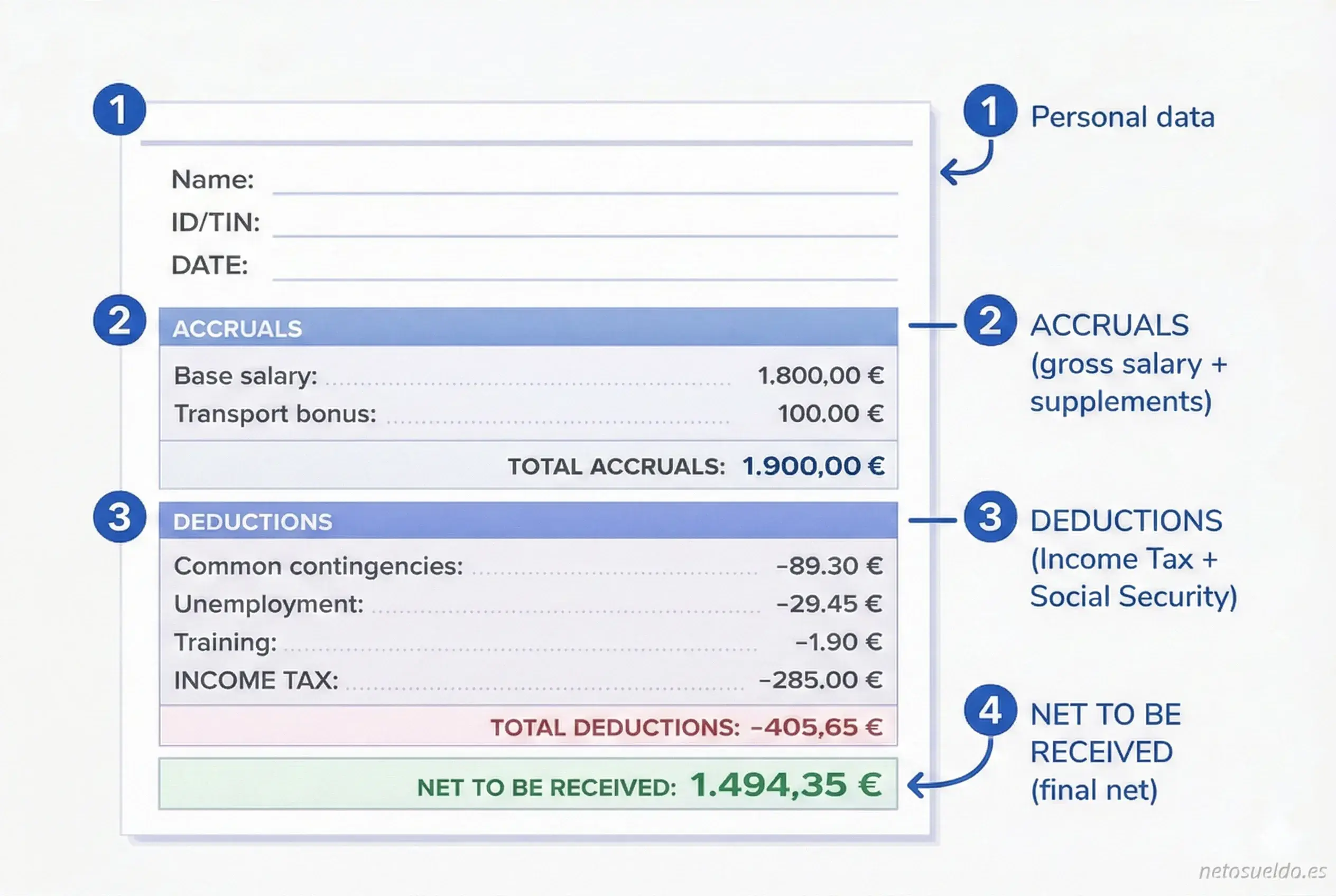
Let's analyze each part in detail.
1. Identification data (header)
At the top of the payslip you'll find:
Company data
- Company name
- Tax ID (CIF)
- Registered address
- Social Security contribution account code
Worker data
- Full name
- ID number (NIF/NIE)
- Social Security affiliation number
- Professional category (technician, administrative, etc.)
- Contribution group (from 1 to 11)
- Seniority in the company
Settlement period
- Month and year the payslip corresponds to
2. Earnings: what you earn
Earnings are all the items that add to your salary. They are divided into two types:
A) Salary payments (contribute and are taxed)
These items contribute to Social Security and are taxed:
Base salary
It's the remuneration set in your contract or collective agreement according to your professional category.
Example: Monthly base salary: €1,400
Salary supplements
These are additional amounts to the base salary:
- Seniority bonus: For years worked in the company
- Night work bonus: For working at night (10pm-6am)
- Hazard/toxicity bonus: For risky work
- Transport allowance: Help for commuting
- Incentives or commissions: Based on targets or sales
- Overtime: Paid separately from base salary
- Collective agreement bonus: According to collective agreement
Example:
- Seniority bonus: €50
- Transport allowance: €100
- Overtime: €80
Extra payments
In Spain it's common to have 14 payments (12 regular + 2 extras):
- Summer payment (June or July)
- Christmas payment (December)
Extra payments can be:
- Non-prorated: Paid in June and December (double payments)
- Prorated: Distributed among the 12 monthly payments
Example:
- Extra payment prorated (1/12): €150
👉 See differences between prorated and non-prorated payments
B) Non-salary payments (don't contribute or are taxed, or partially)
These items don't contribute to Social Security (or only partially):
- Per diems: Meal expenses on work trips (exempt up to limits)
- Transport allowance: Exempt up to certain limits
- Compensation: For dismissal, relocation, etc.
- Social Security benefits: Temporary disability (sick leave)
- Voluntary improvements: Insurance, meal vouchers (exempt up to limits)
Example:
- Per diems (work trip): €60
- Meal vouchers: €220 (€11/day × 20 days)
Total earnings
It's the sum of all earnings (salary + non-salary).
Example of earnings section:
| Item | Amount |
|---|---|
| Base salary | €1,400.00 |
| Seniority bonus | €50.00 |
| Transport allowance | €100.00 |
| Overtime | €80.00 |
| Extra payment prorated | €150.00 |
| Total earnings | €1,780.00 |
3. Deductions: what is deducted
Deductions are the amounts subtracted from your salary. There are two main types:
A) Worker's Social Security contribution
These are mandatory contributions you pay to be entitled to:
- Public healthcare
- Unemployment benefit
- Retirement
- Temporary disability (sick leave)
Contribution items (2026)
| Item | % of base | Who pays? |
|---|---|---|
| Common contingencies | 4.70% | Worker |
| Unemployment (permanent) | 1.55% | Worker |
| Unemployment (temporary) | 1.60% | Worker |
| Professional training | 0.10% | Worker |
| MEI 2026 | 0.15% | Worker |
| Total worker | 6.50% | Worker |
📌 MEI 2026: The Intergenerational Equity Mechanism is an additional mandatory contribution since 2023 that increases progressively each year:
- 2023: 0.10% | 2024: 0.12% | 2025: 0.13% | 2026: 0.15% | 2027: 0.17% | 2028: 0.18% | 2029: 0.20%
- It serves to guarantee the sustainability of the pension system.
Note: The company also contributes for you (approximately an additional 30%, but that doesn't appear on your payslip).
Contribution bases
Contributions are calculated on the contribution bases, which are:
- Common contingencies base: Includes base salary + supplements + extra payments prorated
- Professional contingencies base: Similar to the above
- Overtime base: Only on overtime worked
Contribution example (2026):
If your contribution base is €1,730:
- Common contingencies (4.70%): €81.31
- Unemployment (1.55%): €26.82
- Professional training (0.10%): €1.73
- MEI 2026 (0.15%): €2.60
- Total contribution: €112.46
B) Income Tax (IRPF)
Income Tax is the tax on your earnings. It's applied through withholding directly on your payslip.
How is the withholding percentage calculated?
Your company calculates your income tax withholding based on:
- Your estimated annual gross salary
- Your personal situation (children, disability, age)
- Your autonomous community
- Number of payments
Typical withholding percentages:
- Low salaries (€15,000-€20,000): 2-8%
- Medium salaries (€25,000-€35,000): 10-16%
- Medium-high salaries (€40,000-€60,000): 17-23%
- High salaries (>€60,000): 25-35%
Example:
If your gross monthly salary is €1,780 and your withholding is 12%:
- Income Tax: €1,780 × 12% = €213.60
👉 Income Tax explained in detail
C) Advances and other deductions
Other items that may appear:
- Advances: Money the company advanced you
- Value of in-kind products: Company car, housing
- Court order garnishment: If you have debts with court order
Total to deduct
It's the sum of all deductions.
Example of deductions section:
| Item | Base | % | Amount |
|---|---|---|---|
| Common contingencies | €1,730 | 4.70% | €81.31 |
| Unemployment | €1,730 | 1.55% | €26.82 |
| Professional training | €1,730 | 0.10% | €1.73 |
| MEI 2026 | €1,730 | 0.15% | €2.60 |
| Income Tax | €1,780 | 12% | €213.60 |
| Total to deduct | €326.06 |
4. Total net pay: what you receive
It's the net amount you'll receive in your bank account:
Net pay = Total earnings - Total deductions
Example:
- Total earnings: €1,780.00
- Total deductions: -€326.06
- Net pay: €1,453.94
This is the amount you'll see in your bank account.
Complete payslip example
Worker data
- Name: María García López
- Category: Administrative
- Contribution group: 7
- Period: January 2026
Earnings
| Item | Amount |
|---|---|
| Base salary | €1,400.00 |
| Seniority bonus | €50.00 |
| Transport allowance | €100.00 |
| Overtime | €80.00 |
| Extra payment prorated | €150.00 |
| Total earnings | €1,780.00 |
Deductions
| Item | Base | % | Amount |
|---|---|---|---|
| Common contingencies | €1,730 | 4.70% | €81.31 |
| Unemployment | €1,730 | 1.55% | €26.82 |
| Professional training | €1,730 | 0.10% | €1.73 |
| MEI 2026 | €1,730 | 0.15% | €2.60 |
| Income Tax | €1,780 | 12.00% | €213.60 |
| Total deductions | €326.06 |
Net pay
Net to receive: €1,453.94
How to verify if your payslip is correct
1. Check the base salary
Verify it matches:
- Your employment contract
- The collective agreement for your sector
- The salary agreed in the offer
2. Review the extra payments
If you have 14 payments:
- Non-prorated payments: You should receive double in June and December
- Prorated payments: "Extra payment prorated" should appear every month
Monthly prorate calculation:
Monthly prorate = (Base salary + supplements) / 12
3. Verify Social Security contributions
It must be exactly 6.50% of your contribution base in 2026 (includes MEI 0.15%).
Calculation:
Contribution = Contribution base × 6.50%
4. Review Income Tax
The percentage should be consistent with your annual salary:
- Low salaries: 5-10%
- Medium salaries: 10-16%
- High salaries: 17-25%
If you think it's too high or low, you can ask your company to review it (form 145).
5. Compare with online calculators
Use our calculator to verify if your net is correct:
👉 Calculate your expected net salary
Common payslip errors
1. Incorrect base salary
Solution: Check your contract and collective agreement. Talk to HR.
2. Extra payments not applied
Solution: Verify if they're prorated or if you'll receive them in June/December.
3. Income Tax too high
Solution: Fill out form 145 with your updated family situation (children, disability).
4. Unpaid overtime
Solution: Check your time record. Overtime must be paid or compensated.
5. Seniority not reflected
Solution: Check the collective agreement. Not all have seniority bonus.
Key concepts to understand your payslip
Gross salary
It's the sum of all salary earnings before deductions. It's the figure that appears in your contract.
Net salary
It's the net pay, what you actually receive in your account after deductions.
👉 Difference between gross and net salary
Contribution base
It's the amount on which Social Security contributions are calculated. It affects:
- Your future retirement pension
- Unemployment benefit
- Temporary disability (sick leave)
Higher base = better future pension (but also more monthly contribution)
Regulatory base
It's the average of your contribution bases from recent years. It's used to calculate:
- Retirement pension
- Unemployment benefit
Contribution group
Classifies your position by qualification level (from 1 to 11):
- Group 1: Engineers, graduates
- Group 2: Technical engineers, diploma holders
- Group 3: Administrative and workshop managers
- Groups 4-7: Administrative staff, assistants, subordinates
- Groups 8-11: Skilled and unskilled workers
💼 Verify if your payslip is correct
Compare your payslip net with our calculation:
👉 Calculate my expected net salary →
Conclusion
Understanding your payslip is essential to:
- ✅ Verify you're paid what was agreed
- ✅ Detect errors in time
- ✅ Know your contributions (affect your retirement)
- ✅ Plan your personal finances
Remember:
- Total earnings: What you earn
- Total deductions: What is taken (Social Security + Income Tax)
- Net pay: What you receive in your account
If you have questions about your net salary:
👉 Calculate your expected net salary here
Related guides
Frequently asked questions
Solve the most common questions about this topic
Calculate your net salary now
Get your personalized result in less than 1 minute