Income Tax in Spain: What It Is, How It Works and How It's Calculated (2026)
Income tax explained: what it is, how progressive brackets work, differences by region and calculation examples. Clear and updated 2026 guide. Understand it!
💡 Want to know exactly how much income tax you would pay based on your salary and region?
👉 Income tax calculator: discover your real withholding
What is income tax (IRPF)?
IRPF (Impuesto sobre la Renta de las Personas Físicas) is the tax that reduces your salary the most in Spain. It applies to the income you earn throughout the year and is deducted directly from your payslip through withholdings.
Income tax is a progressive tax, which means:
- The more you earn, the higher percentage you pay
- Not all your salary is taxed at the same rate
- The calculation depends on your personal situation and your autonomous community
That's why two people with the same gross salary can pay different income tax.
How income tax works: bracket system
Income tax is calculated using income brackets. Each bracket is taxed at a different percentage. Only the portion of salary falling in a bracket pays that rate, not the total.
General income tax brackets (2026)
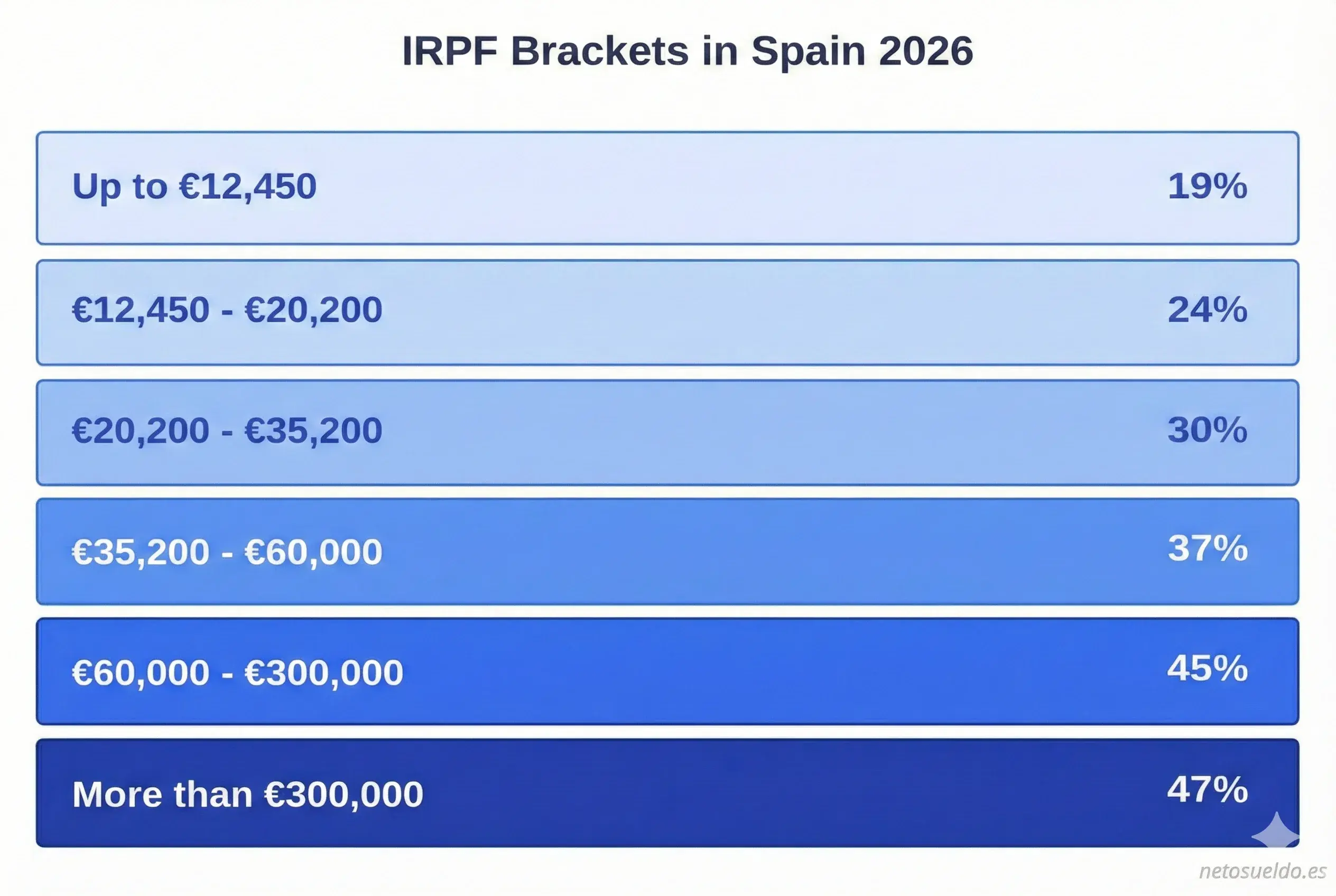
🔄 Updated 2026: Approximate combined rates (state + average regional)
(Indicative rates that vary by autonomous community)
- From 0 to €12,450 → 19% (approx.)
- From €12,450 to €20,200 → 24% (approx.)
- From €20,200 to €35,200 → 30% (approx.)
- From €35,200 to €60,000 → 37% (approx.)
- From €60,000 to €300,000 → 45% (approx.)
- More than €300,000 → 47% (approx.)
👉 Important:
These percentages are not applied to your entire salary, but bracket by bracket. Additionally, actual rates vary by autonomous community: Madrid applies lower rates, Catalonia and other communities apply higher rates.
State portion and regional portion
Income tax is divided into two components:
- State portion (same throughout Spain)
- Regional portion (depends on the community)
Each autonomous community can modify its regional rates, which generates significant differences in final net salary.
Differences by autonomous community
- Madrid applies lower regional rates
- Catalonia, Andalusia or Valencia apply higher rates in middle and high brackets
This can mean between €200 and €600 more or less per year with the same gross salary.
👉 Check the details at
Calculator by autonomous communities
Practical income tax calculation example
Let's assume an annual gross salary of €40,000, for a person:
- Under 65 years old
- Without children
- Without disability
- Permanent contract
🔄 Updated January 2026 with official SS 2026 data (MEI: 0.15%) and 2025/2026 income tax brackets
Approximate deductions (varies by community)
Social Security (6.50%):
- SS contributions: ≈€2,600
Income tax (varies by autonomous community):
- Madrid: ≈€7,204 (18.0% effective) - Lowest income tax
- Catalonia: ≈€7,936 (19.8% effective) - Highest income tax
- Other communities: ≈€7,400-€7,800
Approximate net salary by community
- Madrid: ≈€30,196 net/year (≈€2,157/month in 14 payments)
- Catalonia: ≈€29,464 net/year (≈€2,105/month in 14 payments)
- Other AC: ≈€29,600-€29,900 net/year
Madrid-Catalonia difference: ≈€732/year more in Madrid
💼 Calculate your exact income tax
Want to know how much income tax you'll pay with your real salary?
👉 Calculate with €40,000 | With €50,000 | With €60,000
⚠️ This calculation is for guidance only. The actual result depends on your community and personal situation.
Factors that influence income tax
Autonomous community
Each community sets its portion of income tax. Madrid is one of the most fiscally favorable, while others apply higher pressure on middle and high brackets.
Number of payments
Extra payments also pay income tax. In months with double payments, withholding may seem higher, although it's regularized at year end.
Prorated vs non-prorated payments
Personal and family situation
Income tax is reduced through personal and family minimums, including:
- Children: increasing family minimums
- Over 65 years: +€1,150
- Over 75 years: +€1,400 additional
- Disability: additional minimums between €3,000 and €9,000
These amounts reduce the base on which income tax is calculated, making you pay less tax.
Calculate your real income tax and net salary
If you want to know how much income tax you would really pay based on your salary, community and personal situation:
👉 Income tax and net salary calculator by community
⚠️ This calculation is for guidance only and does not replace an actual payslip or professional tax advice.
Related guides
Understand your payslip
- How to calculate your net salary step by step
- Gross vs net salary: key differences
- Prorated payments and their impact on income tax
Examples by salary
- Net salary with €25,000 gross: applied income tax
- Net salary with €30,000 gross: real withholding
- Net salary with €40,000 gross: higher brackets
Differences by community
Frequently asked questions
Solve the most common questions about this topic
Calculate your net salary now
Get your personalized result in less than 1 minute