Net salary self-employed: how much to invoice (2026)
How much do you earn as a freelancer? Income tax, self-employed fee, deductions, comparison vs employee and how to optimize. Calculate your real net!
Are you an employee and want to compare with being freelance? Calculate your net salary as an employee
How much do you really earn as a freelancer in Spain?
Being a freelancer or self-employed (autónomo) in Spain is very different from being an employee. Your real net salary depends on:
- Annual billing
- Deductible expenses
- Self-employed fee
- Quarterly income tax
- VAT (which isn't yours)
General rule: To earn the same as an employee with €30,000 gross, a freelancer needs to bill between €35,000 and €40,000 annually.
Costs of being self-employed in Spain
1. Self-employed fee (Social Security)
The monthly fee depends on the contribution base you choose:
- Minimum base (≈€1,000/month): ≈€310/month = €3,720/year
- Medium base (≈€1,500/month): ≈€440/month = €5,280/year
- High base (≈€2,000/month): ≈€580/month = €6,960/year
Flat rate for new self-employed (2026):
- First 12 months: €80/month
- Months 13-24: €160/month (if you meet requirements)
2. Income Tax (IRPF)
Income tax is paid quarterly through form 130 (if you bill without withholding):
Income tax brackets for self-employed (2026):
- Up to €12,450: 19%
- From €12,450 to €20,200: 24%
- From €20,200 to €35,200: 30%
- From €35,200 to €60,000: 37%
- More than €60,000: 45%
Important: Income tax is calculated on net income (revenue - deductible expenses - self-employed fee).
3. VAT (not a real cost)
The VAT you charge your clients (21% general) is not yours. You collect it and return it to the Tax Agency quarterly. You can deduct VAT on your expenses.
4. Accountant
Having an accountant is practically mandatory:
- Monthly cost: €50-€150/month = €600-€1,800/year
Practical example: How much do I earn with €40,000 billed?
Let's assume you bill €40,000 per year (VAT not included) with average deductible expenses:
Income and expenses
- Annual billing: €40,000
- Deductible expenses:
- Self-employed fee: €3,720
- Accountant: €900
- Computer equipment: €1,500
- Internet, phone: €600
- Coworking/office: €2,000
- Training: €800
- Other supplies: €500
- Total expenses: €10,020
Net income calculation
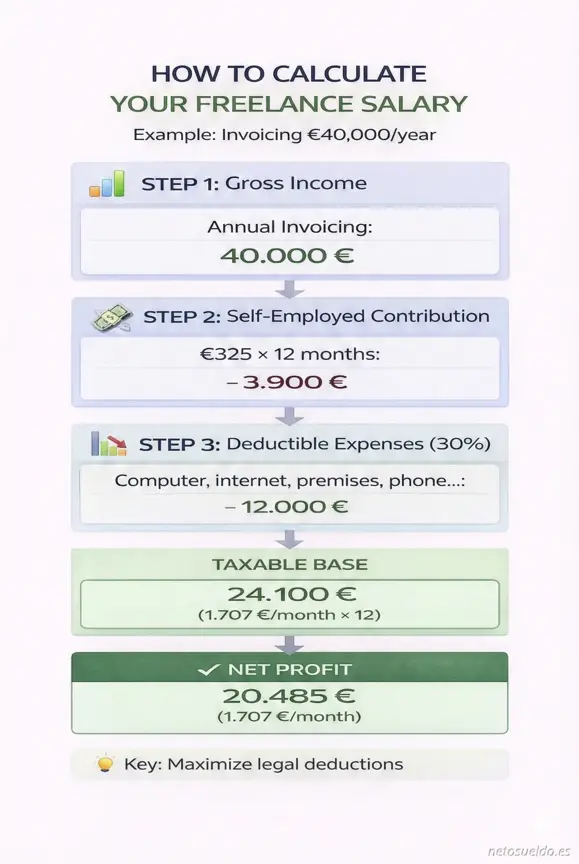
- Net income: €40,000 - €10,020 = €29,980
Income tax to pay
Applying progressive brackets on €29,980:
- First €12,450 at 19%: €2,365
- From €12,450 to €20,200 at 24%: €1,860
- From €20,200 to €29,980 at 30%: €2,934
Total income tax: ≈€7,159
Final net salary
- Net income: €29,980
- Income tax: -€7,159
- Freelancer net salary: ≈€22,821/year (≈€1,630/month in 14 fictitious payments)
Freelance vs employee comparison
With €40,000 billing vs €30,000 gross as employee
| Item | Freelance (€40K billed) | Employee (€30K gross) |
|---|---|---|
| Gross income | €40,000 | €30,000 |
| Deductible expenses | -€10,020 | - |
| Social Security | Included in expenses | -€1,920 |
| Income tax | -€7,159 | -€4,500 |
| Annual net | ≈€22,821 | ≈€23,580 |
| Monthly net | ≈€1,630 | ≈€1,684 |
Conclusion: To match €30,000 gross as an employee, a freelancer needs to bill ≈€40,000 (with average expenses).
Advantages of being freelance
Greater time and location flexibilityYou can deduct many expenses (computer, phone, travel, training) No income limit (you can bill €60K, €80K, €100K...) You choose your clients and projectsPossibility of working with international clientsYou can combine several projects simultaneously
Disadvantages of being freelance
No extra payments, paid vacation or sick leaveYou pay self-employed fee even without billingComplex administrative management (VAT, quarterly income tax, invoices) Less protection against dismissal (your clients can leave) No unemployment benefit (with exceptions) Lower retirement contribution (unless you contribute more) Difficulty accessing mortgages (banks ask for more guarantees)
Key deductible expenses for freelancers
You can deduct all expenses necessary for your activity:
100% deductible expenses
- Self-employed fee
- Accountant and tax advisor
- Office supplies (computer, software, licenses)
- Internet and phone (if exclusive for work)
- Training related to your activity
- Advertising and marketing
- Coworking or office rental
- Work travel (transport, hotels, per diems)
- Professional insurance
Partially deductible expenses (30%)
If you work from home:
- Utilities (electricity, water, gas): 30% proportional
- Home internet: 30% proportional
- Homeowners fees: 30% proportional
Non-deductible expenses
Personal clothing (except specific uniforms) Meals outside work trips Traffic fines Personal expenses unrelated to the activity
Tip: Keep all invoices and receipts. Maximizing deductible expenses significantly reduces your income tax.
How much do I need to bill to live well?
It depends on your lifestyle, but here's a reference:
Freelancer with modest life
- Required billing: €25,000-€30,000/year
- Estimated net salary: €16,000-€19,000/year (≈€1,150-€1,350/month)
- Viable for: Living in small city, sharing apartment, controlled expenses
Freelancer with comfortable life
- Required billing: €40,000-€50,000/year
- Estimated net salary: €23,000-€30,000/year (≈€1,640-€2,140/month)
- Viable for: Living alone in medium/large city, moderate savings, vacations
Freelancer with affluent life
- Required billing: €60,000-€80,000/year
- Estimated net salary: €36,000-€50,000/year (≈€2,570-€3,570/month)
- Viable for: Living in Madrid/Barcelona, significant savings, investments
Tax optimization strategies for freelancers
1. Maximize deductible expenses
Everything you spend on your activity reduces your income tax:
- Buy computer, monitor, keyboard, mouse → deductible
- Online courses, professional books → deductible
- Travel to conferences, networking → deductible
Example: €5,000 more in deductible expenses saves you ≈€1,500 in income tax (30%)
2. Contribute what's needed (at the beginning)
If you're starting, contribute on the minimum base (≈€310/month) the first years. When you bill more and have money left over, increase the base.
Savings: Minimum vs high base = €270/month = €3,240/year
3. Take advantage of the flat rate
New self-employed pay only €80/month the first year. Savings of ≈€230/month = €2,760 the first year.
4. Invoice with withholding
If you invoice Spanish companies, apply the 15% income tax withholding. They advance the tax for you and then you settle in the annual return.
Advantage: You don't pay quarterly income tax (form 130), better cash flow.
5. Consider a limited company (SL)
If you bill more than €60,000-€70,000/year, creating a limited company may be more efficient:
- Corporate tax (25%) vs income tax (37-45%)
- More deductible expenses
- Better professional image
Important: Consult a tax advisor, it has additional costs.
Income tax for self-employed: quick guide
Form 130 (quarterly installment payments)
If you invoice without withholding, you pay income tax each quarter:
- Quarter 1 (Jan-Mar): file in April
- Quarter 2 (Apr-Jun): file in July
- Quarter 3 (Jul-Sep): file in October
- Quarter 4 (Oct-Dec): file in January
How to calculate: (Revenue - Expenses) × 20% - previous payments
Tax Return (annual)
In April-June of the following year you file the definitive return. The Tax Agency adjusts what was paid quarterly:
- If you overpaid → they refund you
- If you underpaid → you pay the difference
Income tax explained step by stepIncome tax for self-employed in detail
Conclusion
Being a freelancer in Spain can be very profitable if you bill well and optimize expenses. As a general rule:
- To match €25,000 gross → bill ≈€32,000-€35,000/year
- To match €30,000 gross → bill ≈€40,000-€43,000/year
- To match €40,000 gross → bill ≈€55,000-€60,000/year
Advantages: Flexibility, unlimited income potential, tax deductions Disadvantages: No paid vacation, administrative management, less protection
If you're an employee and want to compare:
Calculate your net salary as an employee
Freelance vs employee: the real comparison
The big difference is not just IRPF, but the self-employed contribution: as a freelancer you pay a fixed fee (€80/month the first year with the flat rate, ≈€310/month after) that employees don't have, but in return you can deduct expenses (equipment, training, supplies) that lower your taxable base.
Rule of thumb: to match an employee's net pay, a freelancer usually needs to invoice 30% to 50% more than the equivalent gross salary, depending on deductible expenses.
Related guides
Frequently asked questions
Calculate your net salary now
Get your personalized result in less than 1 minute